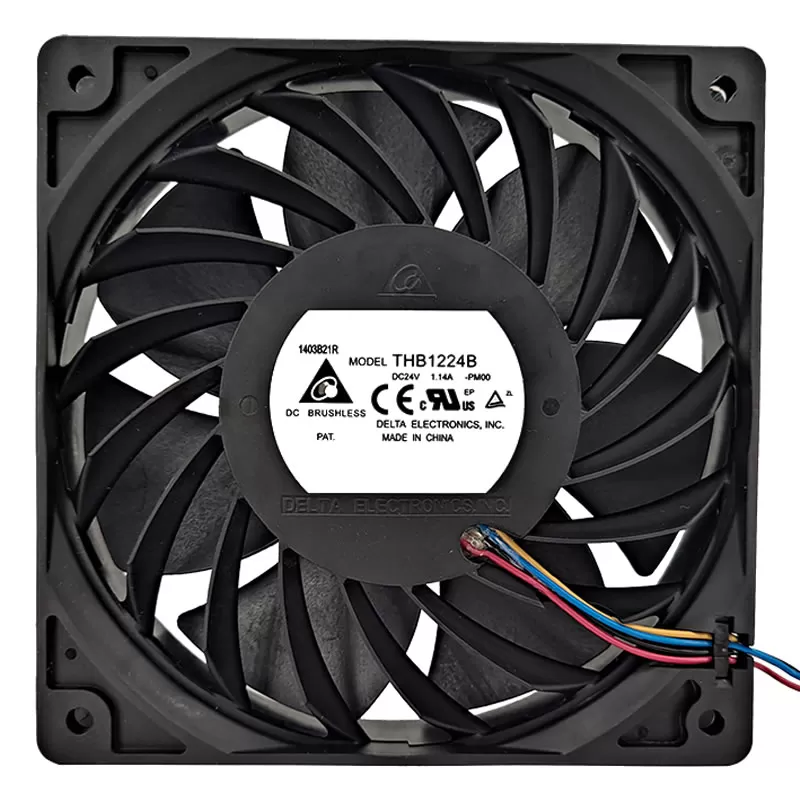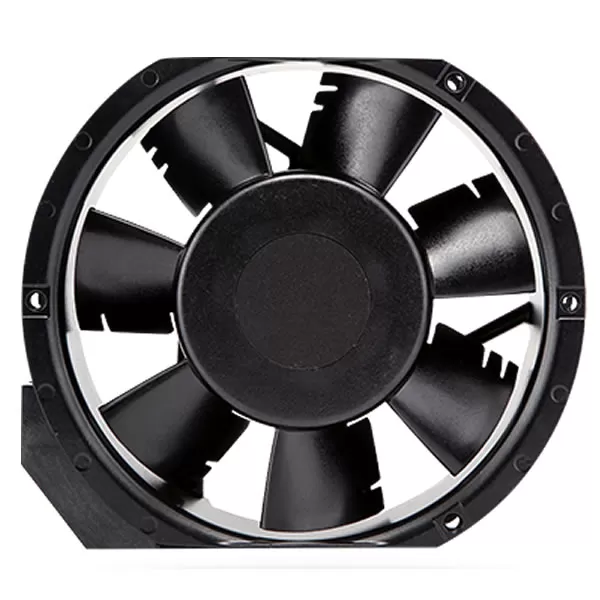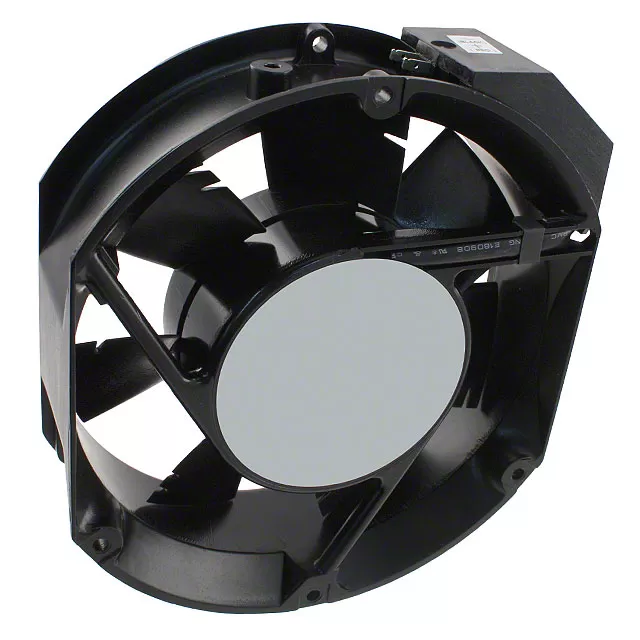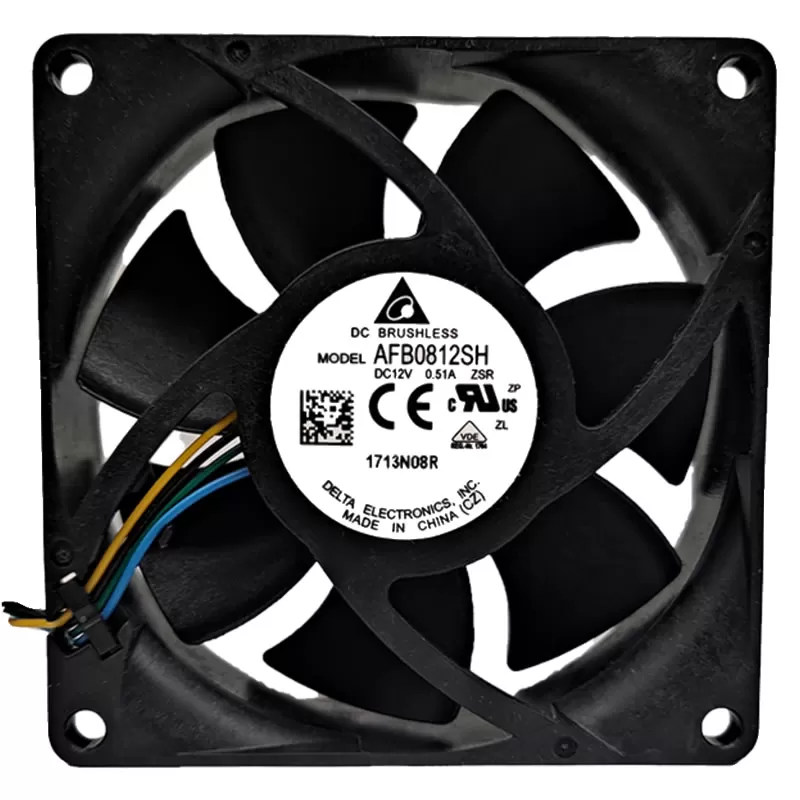
In the modern industrial landscape, energy efficiency is no longer a “nice-to-have” feature—it is a regulatory and financial mandate. As global energy prices fluctuate and sustainability standards like the ErP Directive become more stringent, engineers are moving away from traditional AC motors. However, the choice between Direct Current (DC) and Electronically Commutated (EC) fans often leads to confusion.
While both technologies offer massive savings over traditional AC induction motors, they achieve these savings differently. This guide provides a deep dive into the comparative energy profiles of DC and EC fans to help you determine which technology yields the best ROI for your specific application.
The Efficiency Gap: AC vs. the Modern Standard
To understand why DC and EC fans are superior, we must first look at the inefficiency they replace. Traditional AC motors suffer from induction losses and slip. In an AC motor, significant energy is wasted simply creating the magnetic field in the rotor. DC and EC fans utilize permanent magnets, eliminating these losses entirely and providing an immediate energy reduction of 30% to 70%.
1. DC Fans: Efficiency Through Simplicity
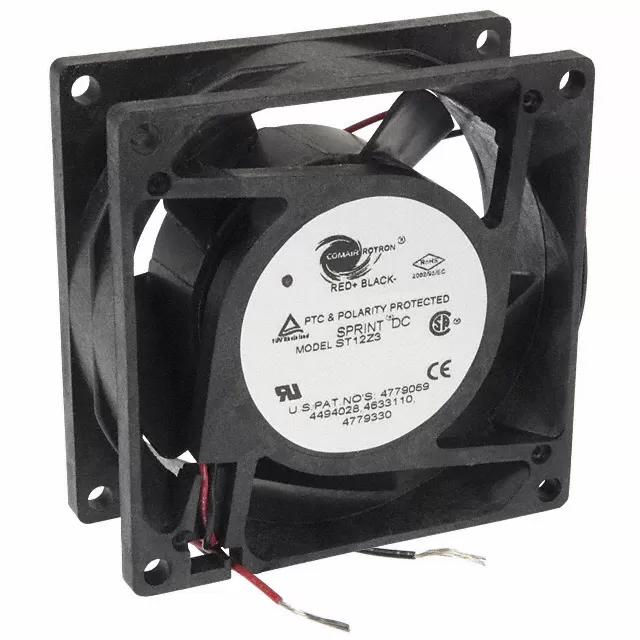
DC fans (typically 12V, 24V, or 48V) are the standard for low-voltage applications. Their energy-saving potential is rooted in their Brushless DC (BLDC) architecture.
Energy Profile
- Mechanical Efficiency: Since the rotor uses permanent magnets, there is no heat buildup from electrical induction in the rotor. This leads to cooler operation and less wasted thermal energy.
- Voltage Control: DC fans save energy by allowing for simple voltage regulation. If a cooling requirement drops, reducing the voltage linearly reduces the power consumption.
The “Hidden” Energy Cost
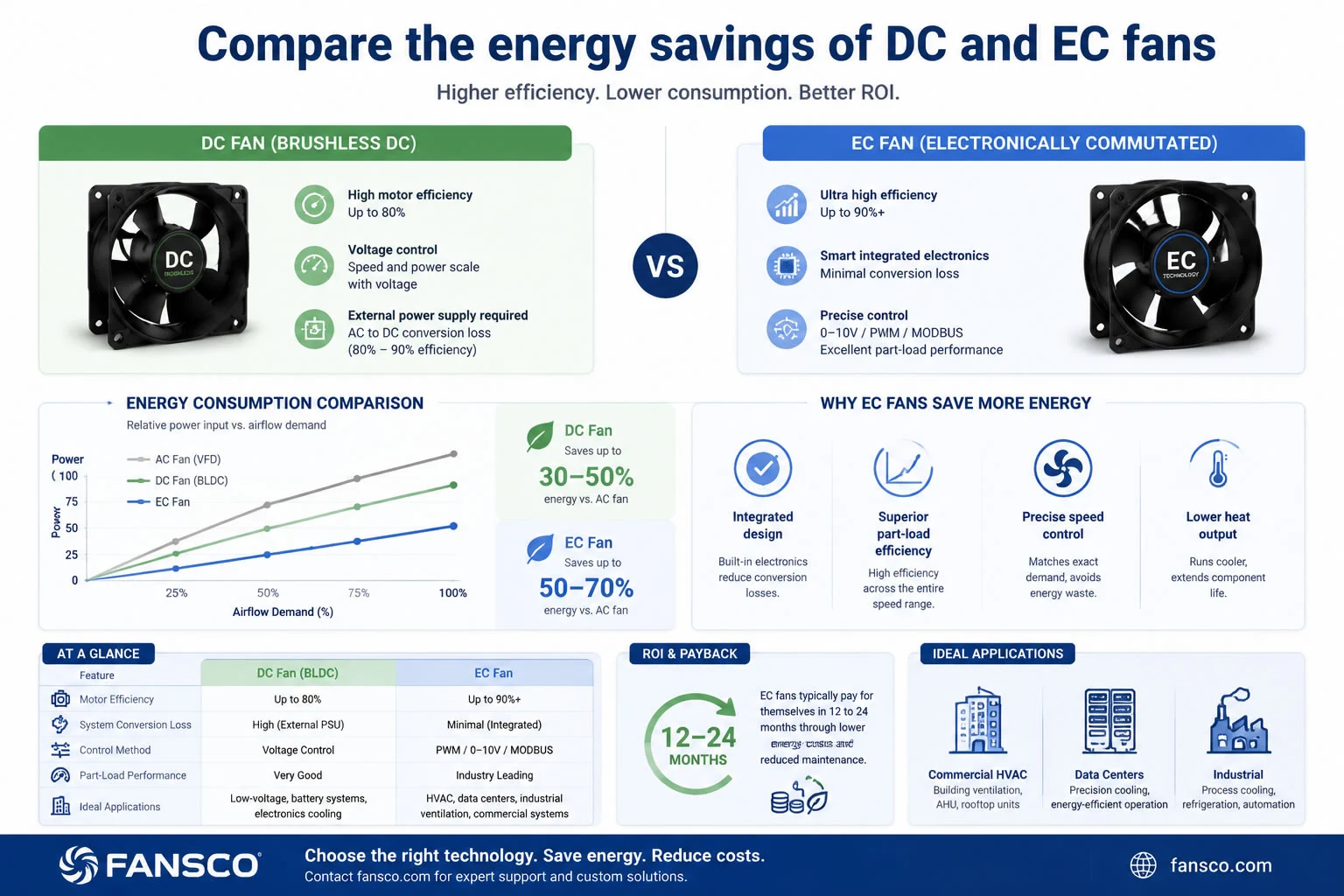
The primary drawback of DC fans regarding energy savings is the external conversion loss. Because most facilities run on AC power, a DC fan requires an external AC-to-DC power supply. These transformers usually operate at 80-90% efficiency. Therefore, when calculating total system energy savings, you must subtract the 10-20% energy lost during power conversion before the electricity even reaches the fan.
2. EC Fans: The Peak of Integrated Efficiency
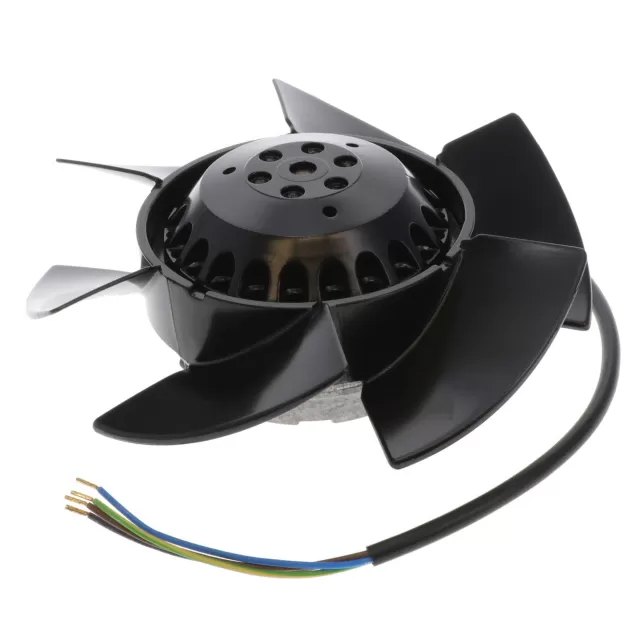
EC fans are essentially “smart” BLDC motors that plug directly into AC mains. They represent the most energy-efficient air-moving technology available today.
Integrated Conversion Savings
Unlike DC fans, EC fans have their power conversion electronics built into the motor. This circuitry is specifically tuned to the motor’s requirements, minimizing conversion losses. An EC fan takes AC power and converts it to DC internally with much higher precision than a generic external power supply.
The Power of Variable Speed (VFD vs. EC)
One of the most significant energy-saving advantages of EC fans is their part-load performance. In many HVAC systems, fans rarely need to run at 100% capacity.
- AC fans with VFDs: Efficiency drops sharply when speed is reduced.
- EC fans: Efficiency remains nearly constant across the entire speed range.
According to the Affinity Laws for centrifugal fans, the power consumed is proportional to the cube of the speed ($P \propto n^3$). Because EC fans can be precisely throttled down via 0-10V or PWM signals to match the exact demand, reducing the fan speed by only 20% can result in nearly a 50% reduction in energy consumption.
Head-to-Head: Energy Savings Comparison
| Factor | DC Fans (Brushless) | EC Fans (Integrated) |
|---|---|---|
| Motor Efficiency | Up to 80% | Up to 90%+ |
| System Conversion Loss | High (External PSU losses) | Minimal (Optimized internal electronics) |
| Control Efficiency | Excellent (Voltage based) | Superior (Microprocessor controlled) |
| Part-Load Performance | Very Good | Industry-Leading |
| Ideal For | Small-scale electronics, Battery systems | Commercial HVAC, Data Centers, Industrial Use |
Total Cost of Ownership (TCO) and ROI
When comparing the energy savings of DC and EC fans, you must look at the Payback Period.
EC fans have a higher initial purchase price due to their complex onboard microprocessors and sensors. However, in a 24/7 industrial environment, the electricity saved by an EC fan over a standard AC or even a basic DC setup often pays for the motor within 12 to 24 months. Furthermore, because EC motors run cooler, the mechanical components (bearings) last longer, reducing the energy and labor costs associated with maintenance and replacement.
Conclusion: Which Saves More?
If you are designing a low-voltage, battery-operated device, DC fans are the most efficient choice because they avoid unnecessary AC-to-DC conversion.
However, for any application connected to the electrical grid—such as refrigeration, cleanrooms, or building ventilation—EC fans are the clear winner. By integrating the electronics and offering superior control under partial loads, EC fans provide the highest energy savings and the lowest carbon footprint of any air-moving technology currently on the market.
At fansco.com, we specialize in high-efficiency EC and DC solutions. Contact our engineering team today to calculate the specific energy savings for your next project.