When designing electronics, automotive systems, or industrial machinery, managing heat is one of the biggest hurdles. If a system gets too hot, efficiency drops, components fail, and lifespans plummet. To prevent this, engineers rely heavily on one specific cooling solution: the DC axial fan.
But what makes this specific type of fan so universal? In this guide, we break down exactly what a DC axial fan is, how it works, and how to specify the right one for your next project.
The Basics: Breaking Down “DC” and “Axial”
To understand the device, you just need to look at its name:
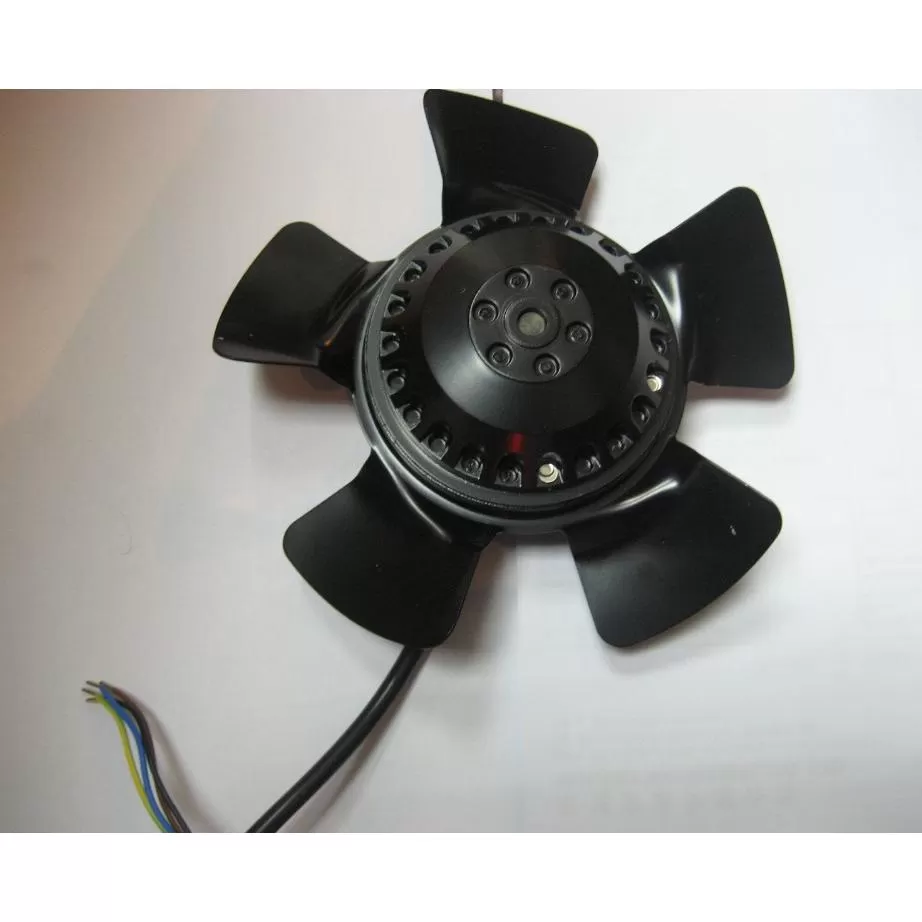
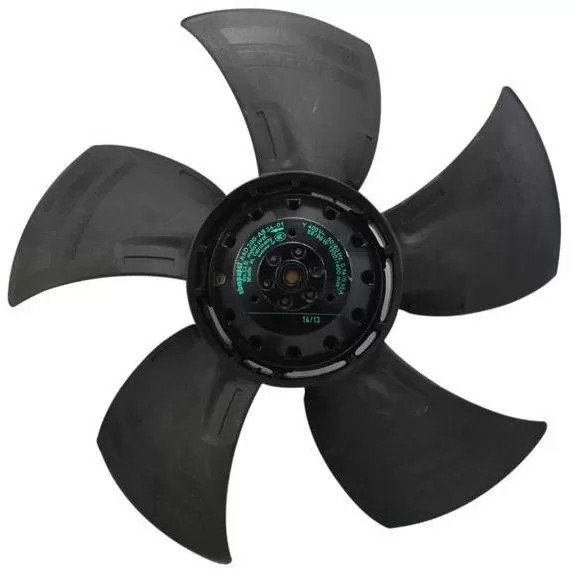
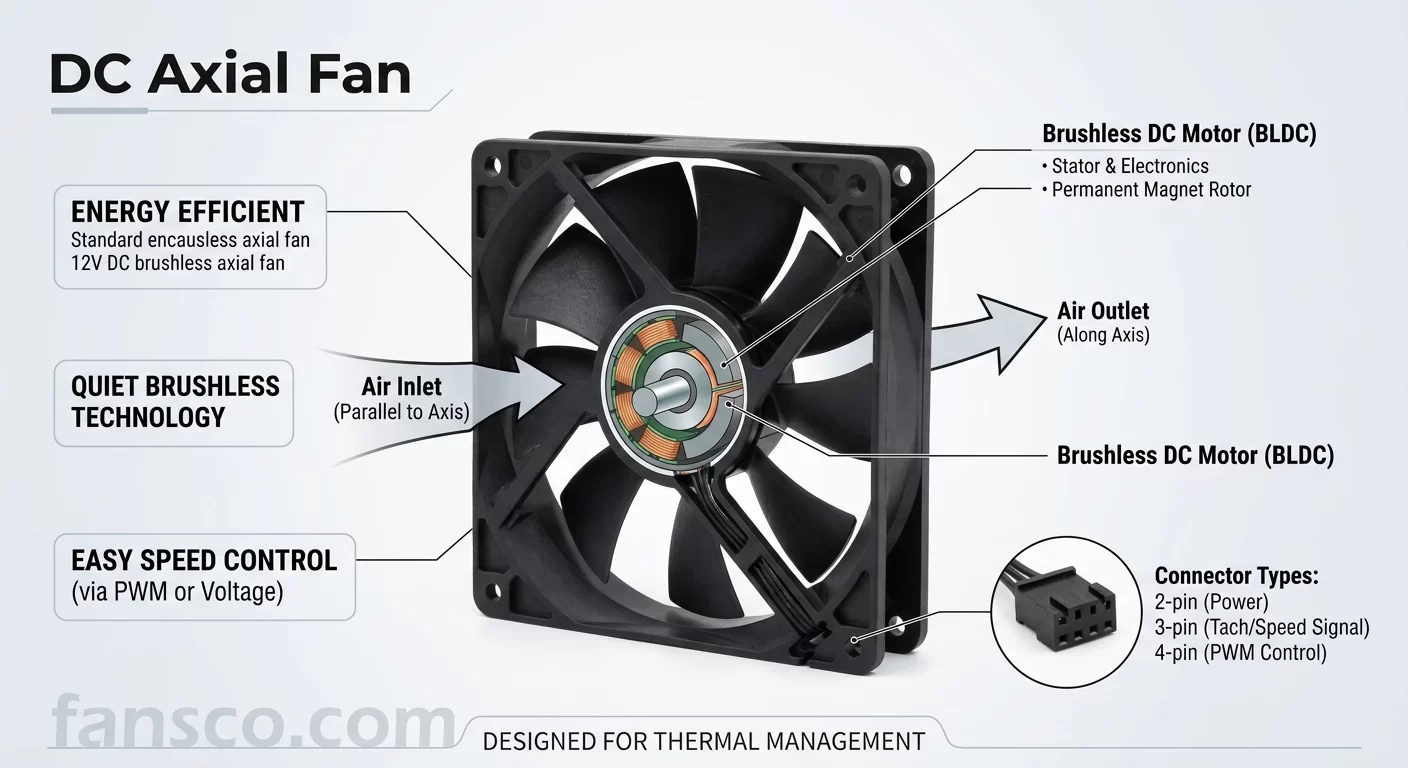
- Axial: This describes the airflow path. The blades rotate around a central axis, drawing air in parallel to that axis and pushing it straight out the other side. Think of a classic airplane propeller.
- DC (Direct Current): This is the power source. Instead of plugging straight into standard wall AC (Alternating Current) power, these fans run on direct current—usually low voltages like 5V, 12V, 24V, or 48V.
How Does It Work?
The vast majority of modern DC axial fans utilize Brushless DC (BLDC) motors. Older brushed motors used physical carbon brushes to transfer current, which caused friction, heat, and eventual wear. Brushless fans eliminate this physical contact.
Instead, a built-in printed circuit board (PCB) sends electrical current to a stationary copper coil (the stator). This generates a magnetic field that pushes against permanent magnets located inside the fan’s central hub (the rotor). By alternating this magnetic force electronically, the fan spins smoothly, quietly, and continuously without any physical friction slowing it down.
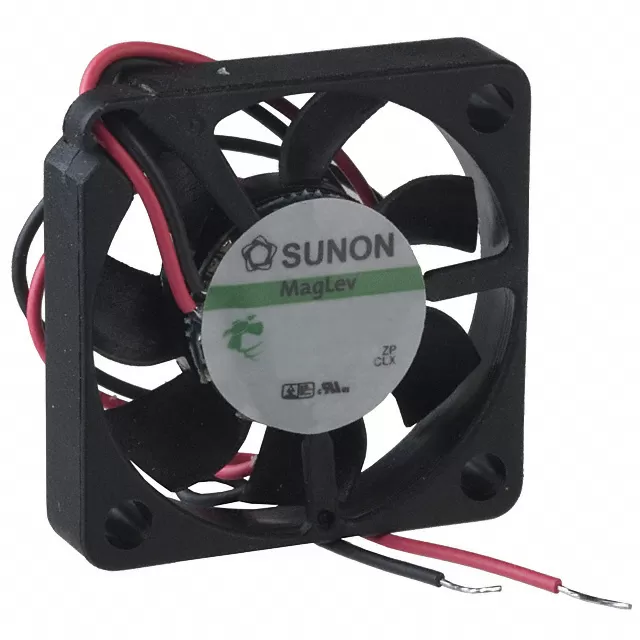
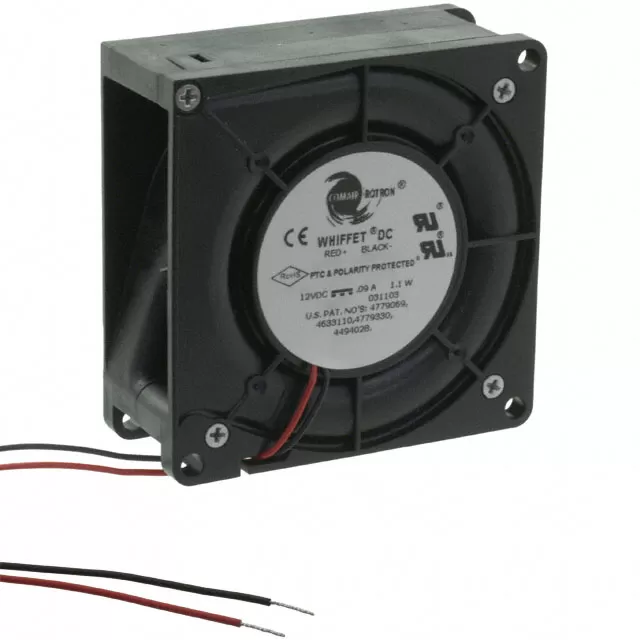
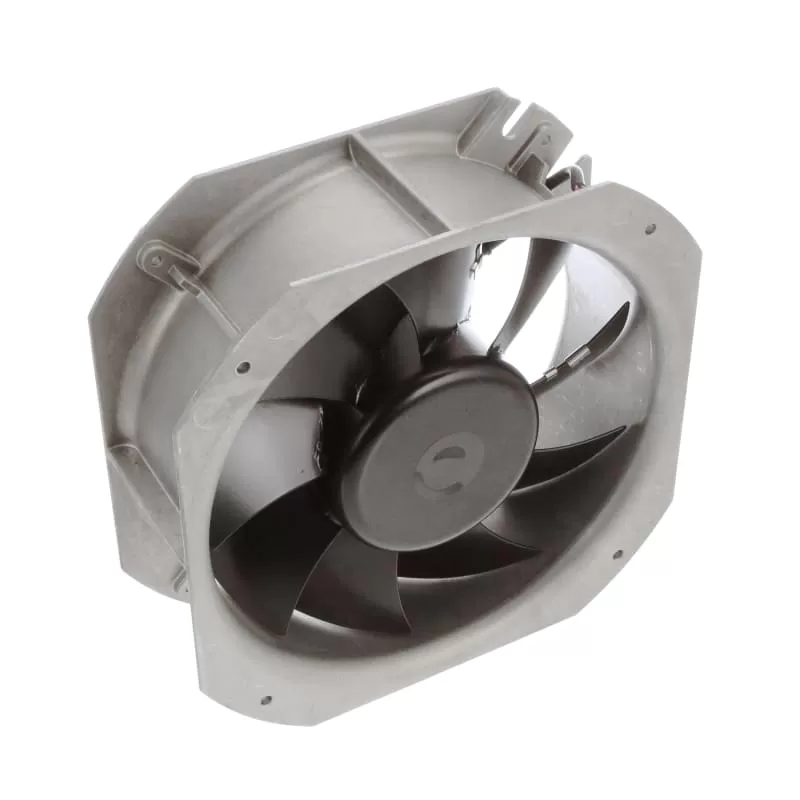
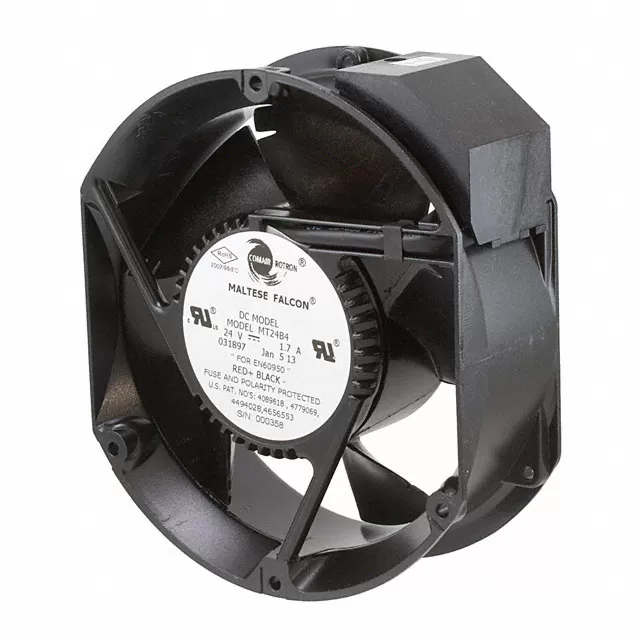
Anatomy of a DC Axial Fan
- Blades (Impeller): Aerodynamically shaped to grab and push air efficiently.
- Hub & Rotor: The central spinning component that houses the permanent magnets and supports the blades.
- Stator & PCB: The stationary internal electronics that provide the electromagnetic driving force.
- Frame: The outer housing, designed to channel the air and provide standard mounting holes for easy installation.
Key Specifications to Know
If you are looking at a fan’s datasheet, you will see a list of technical parameters. Here is what they actually mean for your build:
| Parameter | What It Means |
|---|---|
| Voltage (V) | Usually 5V, 12V, 24V, or 48V. Must match your system’s DC power supply. |
| Airflow (CFM) | Cubic Feet per Minute. Tells you the raw volume of air the fan can move in an open space. |
| Static Pressure (mmH₂O or Pa) | The fan’s ability to push air through resistance (like densely packed wires, heatsinks, or filters). High resistance requires high static pressure. |
| Noise Level (dBA) | How loud the fan is. Lower numbers are quieter. Critical for consumer electronics or office environments. |
| Speed (RPM) | Revolutions Per Minute. Faster speeds usually mean more airflow, but also more noise and power consumption. |
| Bearing Type | Commonly Sleeve (cheaper, quieter at low speeds) or Dual Ball (longer lifespan, better for high temperatures or harsh angles). |
DC vs. AC Axial Fans: Which is Better?
While AC fans have their place in heavy-duty industrial ventilation, DC fans have largely taken over in precision and commercial engineering. Here is a quick comparison:
| Feature | DC Axial Fan | AC Axial Fan |
|---|---|---|
| Power Source | Direct Current (Batteries, DC supplies, Solar) | Alternating Current (Mains 110V/220V) |
| Energy Efficiency | Extremely high (uses up to 70% less power) | Lower |
| Speed Control | Easy and precise via Voltage or PWM | Requires complex external controllers |
| Size & Weight | Compact, lightweight, low profile | Usually bulkier and heavier |
| EMI (Interference) | Very low electromagnetic interference | Higher EMI potential |
Core Advantages of DC Axial Fans
- Direct Compatibility: They integrate seamlessly into battery-operated systems, solar grids, and modern PCB architectures without needing a bulky AC-to-DC converter at the fan level.
- Smart Speed Control: Many DC fans feature a 3-pin or 4-pin connector allowing for PWM (Pulse-Width Modulation). This lets the system automatically speed up the fan when things get hot, and slow it down to a near-silent whisper when the system is idling.
- Incredible Lifespan: Thanks to the brushless design and high-quality ball bearings, a premium DC fan can run continuously for tens of thousands of hours.
Where Are They Used?
Because they are efficient, compact, and easy to control, you will find DC axial fans across a massive range of industries:
- IT & Data Centers: Cooling server racks, power supplies, CPUs, and routers.
- Automotive & EV: Managing heat in electric vehicle battery packs, LED headlamps, and cabin electronics.
- Renewable Energy: Keeping solar inverters and energy storage systems at safe operating temperatures.
- Medical Devices: MRI machines, lab diagnostics, and ventilators where low EMI and zero-failure rates are required.
- Consumer Goods: Everything from your gaming PC to air purifiers and home theater receivers.
How to Select the Right Fan for Your Project
When browsing options, don’t just guess based on size. Follow this quick checklist to ensure optimal cooling:
- Match your power source: Check your voltage and available current limits.
- Evaluate your space: If your enclosure is tightly packed, prioritize Static Pressure over raw CFM. If it’s mostly open, prioritize CFM.
- Consider the environment: Will the fan run 24/7? Choose Dual Ball bearings. Is it going outside or into a dusty factory? Look for an IP55 or IP68 rating for water and dust resistance.
- Determine your control needs: Do you need the fan to run at one constant speed (2-pin), output a speed signal (3-pin), or require full smart-speed control (4-pin PWM)?
Conclusion
DC axial fans are the backbone of modern thermal management. Their ability to deliver high-volume, highly targeted airflow in a compact, energy-efficient package makes them superior to AC alternatives for almost all low-voltage and precision applications. By matching the right voltage, airflow, and bearing type to your specific needs, you ensure your equipment stays cool, quiet, and operational for years to come.
Looking for the right cooling solution? Explore the full range of high-performance DC axial fans at Fansco.com, or contact our team to help specify the perfect fan for your custom application.