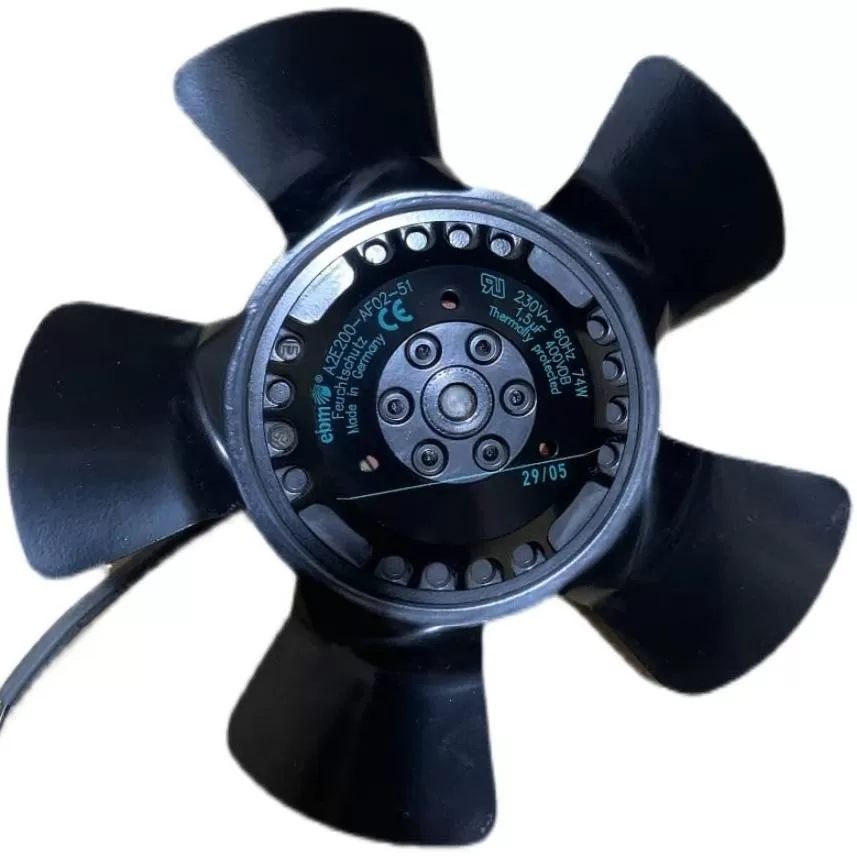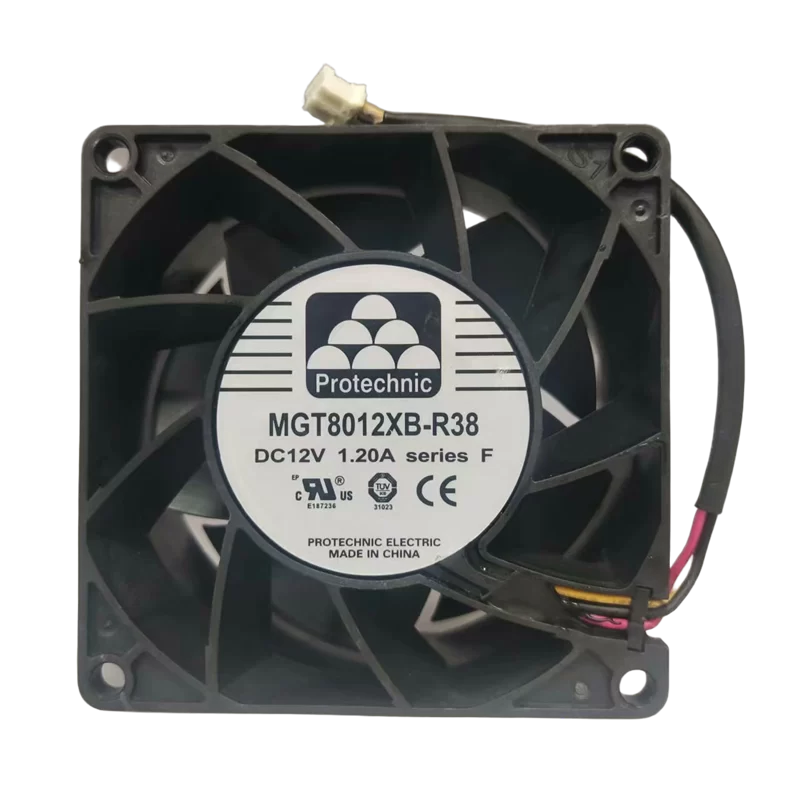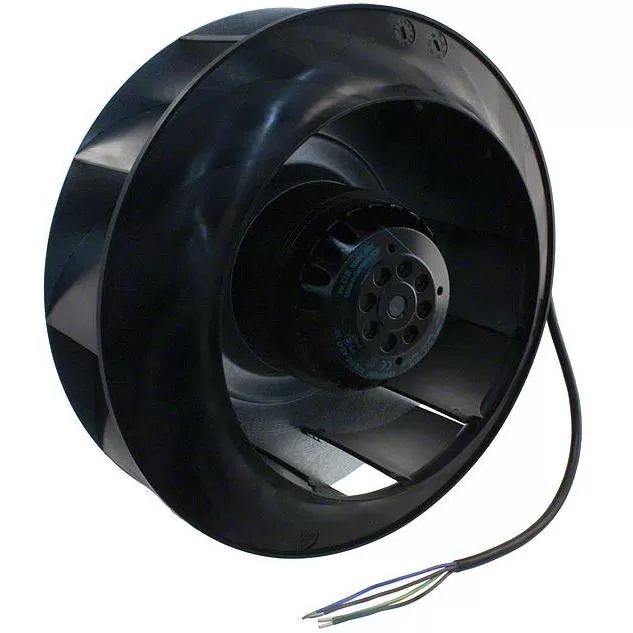
For industrial procurement managers and thermal design engineers, replacing a specialized cooling component is rarely as simple as matching physical dimensions. Sourcing the wrong fan can lead to immediate system fault codes, thermal overload, or compromised equipment efficiency.
When you look at an ebmpapst model number like W1G180-AB31-10 or G4E225-DK05-03, you are not looking at a randomized string of characters. You are reading a highly systematic, condensed technical datasheet.
Decoding this nomenclature correctly reveals the core airflow dynamics, motor technology, and structural framework required for your specific environment. This technical bulletin breaks down the ebmpapst catalog logic, helping you specify, cross-reference, and procure the exact thermal management solution your system demands.
Part 1: The Anatomy of an ebmpapst Part Number
Before diving into the aerodynamic shapes, it is crucial to understand the structural syntax of the model number. Let’s dissect a common industry standard: W1G180-AB31-10.
- W = Aerodynamic Structural Prefix (Axial with wall ring)
- 1G = Motor Technology & Poles (1-phase Electronically Commutated / EC motor)
- 180 = Impeller Diameter (180 mm)
- AB = Mechanical & Aerodynamic Design Variant
- 31 = Electrical Specification & Winding Variant
- -10 = Firmware, OEM Specifics, or Connection Modifications
Understanding this matrix ensures you don’t accidentally swap an intelligent EC motor with a standard AC motor, even if they look identical physically.
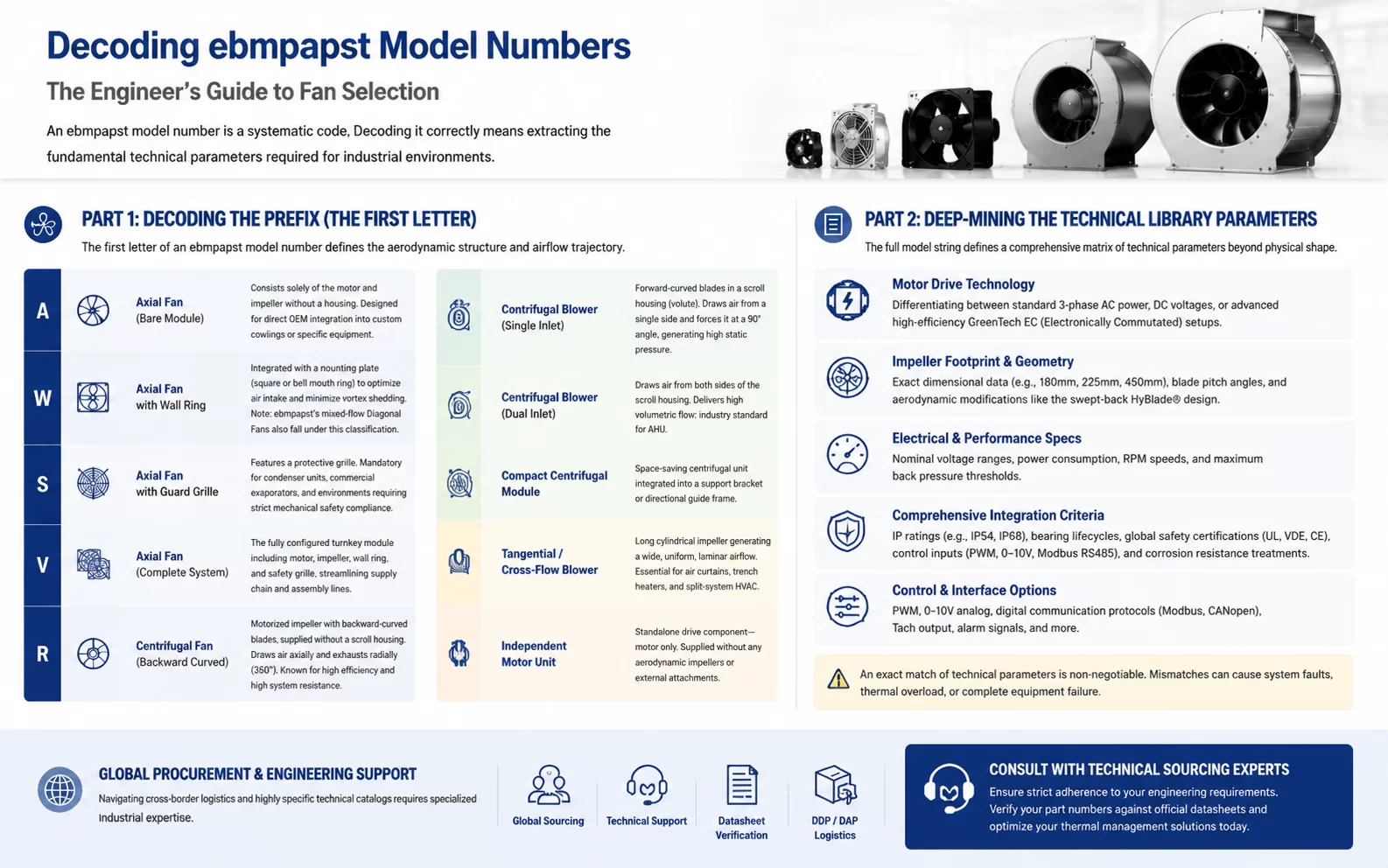
Part 2: The Aerodynamic Structural Prefix (The First Letter)
The initial capitalized letter designates the fundamental mechanical structure and the resulting airflow trajectory. Selecting the correct aerodynamic profile is non-negotiable for overcoming system resistance (static pressure) and meeting volumetric flow (CFM / m³/h) targets.
| Prefix | Aerodynamic Category | Technical Definition & Industrial Application |
|---|---|---|
| A | Axial Fan (Bare Module) | Motor and impeller without a housing. Engineered for direct OEM integration into custom cowlings where space is strictly constrained. |
| W | Axial Fan (Wall Ring) | Integrated with a standard mounting plate (square or full-bell mouth ring) to optimize air intake and minimize vortex shedding. Note: Mixed-flow Diagonal Fans also fall here. |
| S | Axial Fan (Basket Guard) | Features a protective metal/composite grille. Mandatory for condenser units and environments requiring strict compliance with mechanical safety regulations (e.g., finger guards). |
| V | Axial Fan (Complete) | A fully configured turnkey module encompassing motor, impeller, wall ring, and safety grille, streamlining OEM assembly lines. |
| R | Centrifugal (Backward Curved) | Motorized impeller without a scroll housing. Draws air axially and exhausts radially. Highly efficient for overcoming high system resistance (e.g., data centers, CRAC units). |
| G | Centrifugal (Single Inlet) | Forward-curved blades integrated into a scroll housing (volute). Draws air from one side and forces it at a 90° angle. Generates high static pressure for focused cooling. |
| D | Centrifugal (Dual Inlet) | Structurally identical to “G” series but draws air from both lateral sides. Delivers massive volumetric flow rates; the industry standard for Air Handling Units (AHU). |
| K | Compact Centrifugal Module | A space-saving centrifugal unit integrated into a custom support bracket or guide frame, bypassing the need for a traditional bulky scroll housing. |
| Q | Tangential / Cross-Flow | Long, cylindrical impeller generating a wide, uniform, 2D band of laminar airflow. Essential for air curtains, trench heaters, and split-system HVACs. |
| M | Independent Motor Unit | Standalone drive component (motor only). Supplied without any aerodynamic impellers or external attachments. |
Part 3: Deep-Mining the Technical Parameters
While the first letter dictates the shape, the subsequent characters dictate the performance. Substituting a fan based solely on its prefix and diameter without aligning the detailed electrical and software parameters is a critical engineering risk.
Motor Drive Technology (E, D, G)
The characters immediately following the structural prefix indicate the motor’s power phase and technology:
- E = Single-phase AC motor (e.g., 2E, 4E where the number represents the pole count).
- D = Three-phase AC motor (e.g., 2D, 4D).
- G = GreenTech EC (Electronically Commutated) motor. These are highly advanced, efficient DC motors operating on AC power, usually featuring integrated PID controllers and precise speed control via 0-10V or PWM signals.
The Suffix: Variants & OEM Lock-ins (-AB31-10)
The hyphenated characters at the end of the string are arguably the most critical for direct replacements. They define:
- Ingress Protection: Specific IP ratings (e.g., IP54 vs. IP68 for harsh washdown environments).
- Control Inputs: Whether the fan requires a standard tachometer output, PWM input, or Modbus RS485 communication.
- OEM Customizations: Certain suffixes indicate a proprietary firmware programmed for a specific HVAC manufacturer. An off-the-shelf fan with a slightly different suffix may physically fit, but the equipment’s motherboard may reject it due to software mismatch.
Global Procurement & Engineering Support
Navigating cross-border logistics and highly specific technical catalogs requires specialized industrial expertise. Whether you are dealing with end-of-life (EOL) legacy components, migrating from AC to high-efficiency EC technology, or configuring multi-unit supply chains with strict DDP/DAP terms, precision is paramount.
Don’t leave thermal management to chance.
Before finalizing a BOM (Bill of Materials) or authorizing a critical replacement, consult with specialized sourcing experts. By verifying part numbers against official datasheet matrices, you guarantee strict adherence to your engineering requirements, mitigate downtime, and optimize system performance.
Reach out to the FansCo technical procurement team today to verify your ebmpapst model numbers and streamline your global sourcing strategy.