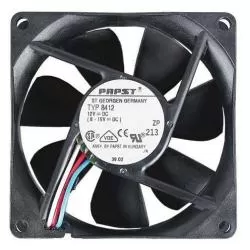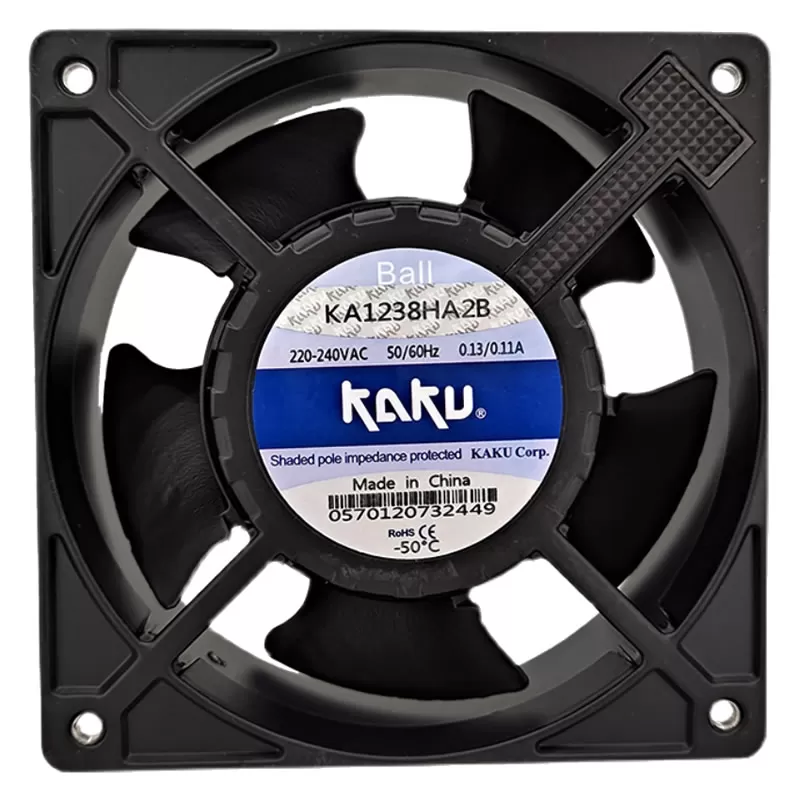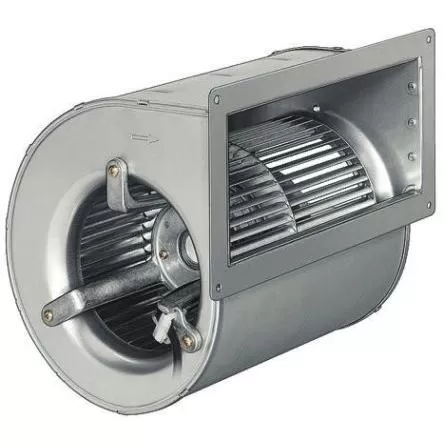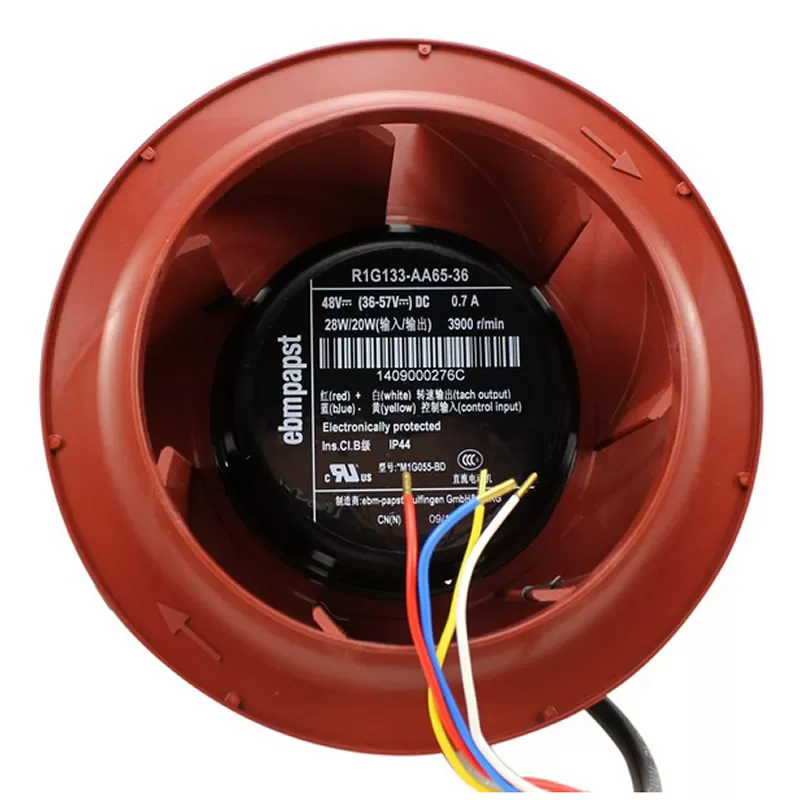
Understanding the ebmpapst Nomenclature
For hardware engineers, thermal designers, and procurement teams sourcing components on FansCo, an ebmpapst part number is a highly structured technical specification. Recognizing the logic behind these codes eliminates the need to cross-reference catalogs for basic parameters like voltage, form factor, or motor type. ebmpapst utilizes distinct naming conventions depending on the product category: one for industrial/heavy-duty fans and another for compact equipment cooling fans, alongside a modernized global identification system.
System 1: Industrial & Classic Series Nomenclature
This system applies to large axial fans, centrifugal blowers, and standalone motors. The structure follows a precise sequence: Type + Motor/Poles + Power + Diameter – Mechanical – Electrical – Variant.
The Structural Breakdown
- Type (1st Letter):
A = Axial fan (without housing)
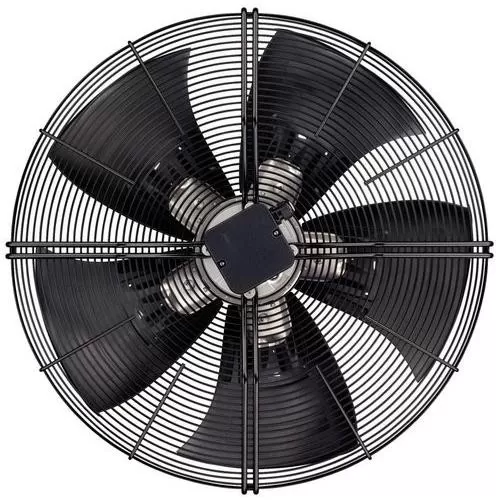
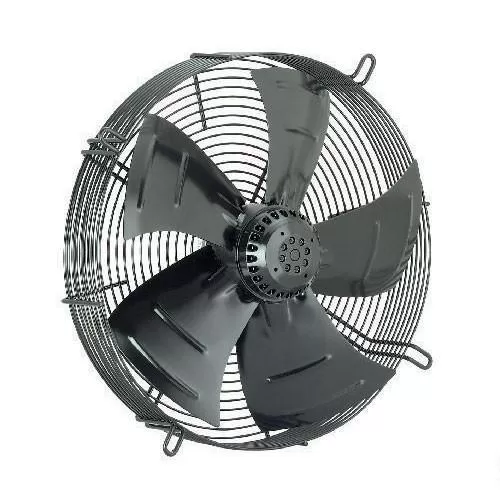
S = Axial fan (with guard grille)
W = Axial fan (with wall ring)
V = Diagonal fan
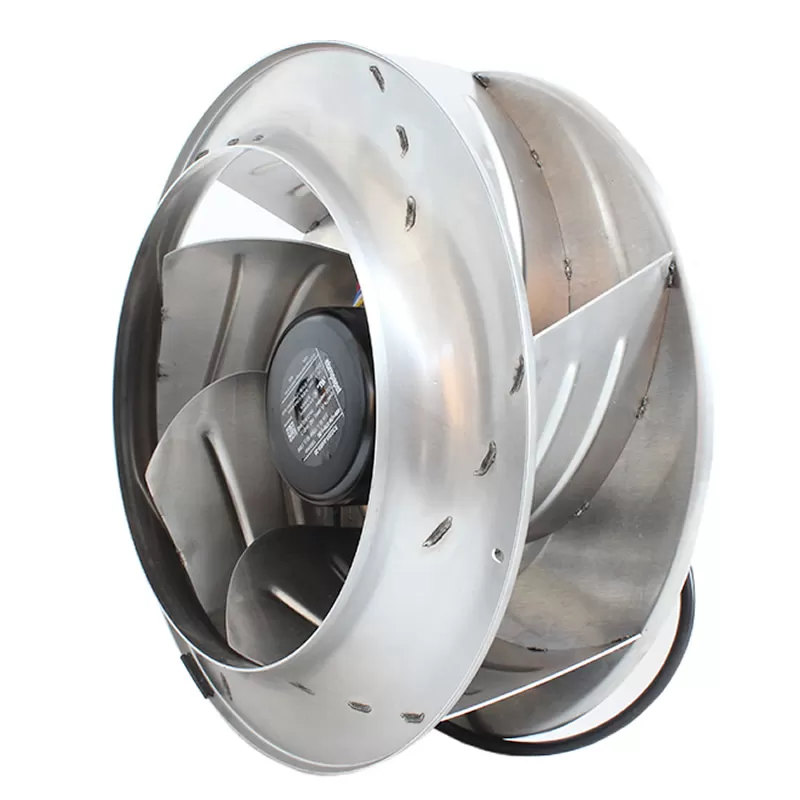
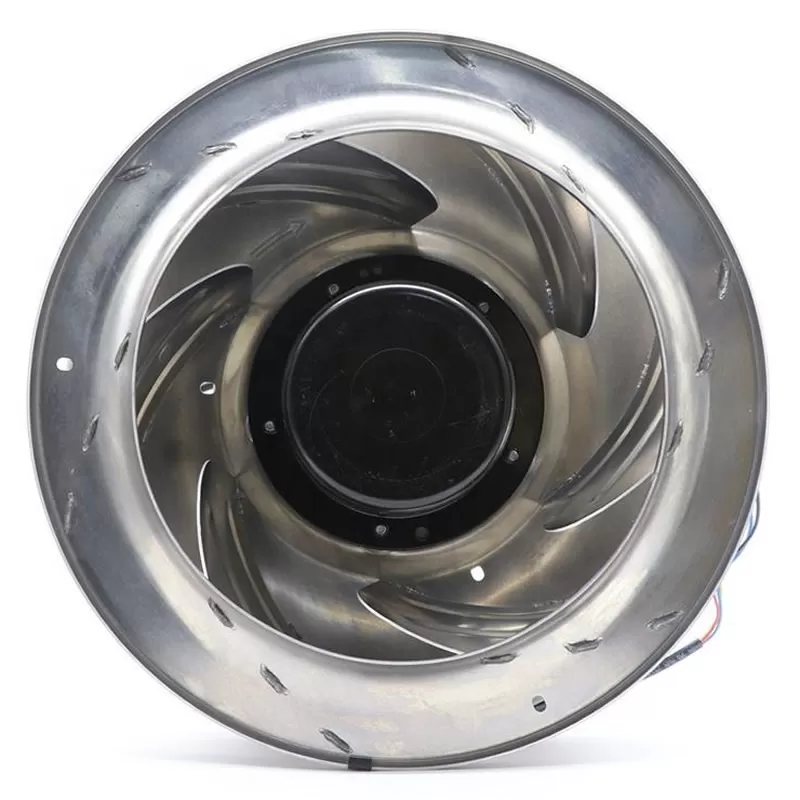
R = Centrifugal fan, backward-curved (single inlet, no scroll housing)
G = Centrifugal blower, forward/backward-curved (single inlet, with scroll housing)
D = Centrifugal blower, forward-curved (dual inlet, with scroll housing)
M = Motor only
- Motor / Poles (2nd Digit): Indicates the number of motor poles for AC motors (2, 4, 6, 8). For EC motors, 1 or 3 indicates the EC generation rather than pole count.
- Power Supply (3rd Letter):
E = Single-phase AC (requires run capacitor)
D = Three-phase AC
G = EC (Electronically Commutated) / DC motor
S = Shaded-pole motor
- Impeller Diameter (Digits 4-6): The outer diameter of the impeller in millimeters (e.g., 200 = 200 mm).
- Mechanical Design (Next 2 Letters): Internal ebmpapst codes for housing shape, blade material (e.g., HyBlade), or mounting points.
- Electrical Design (Next 2 Digits): Specifies the exact winding for target voltage and frequency.
- Variant Suffix (Final 2 Digits): Denotes standard catalog items (usually -01) or customer-specific OEM modifications (-05, -12, etc.).
Decoding Real-World Industrial Examples
Example 1: S4E300-AS52-05 (Guarded Axial Fan)
- S: Axial fan equipped with a guard grille.
- 4: 4-pole motor (moderate speed).
- E: Single-phase AC motor.
- 300: Impeller diameter of 300 mm.
- -AS: Mechanical design revision.
- 52: Specific electrical winding configuration.
- -05: OEM variant.
Application: Used in commercial refrigeration condensers and industrial evaporators.
Example 2: R3G310-AN43-71 (Backward-Curved Centrifugal Fan)
- R: Motorized impeller, backward-curved, single inlet without scroll housing.
- 3: Generation 3 EC technology.
- G: EC motor (Electronically Commutated).
- 310: Impeller diameter of 310 mm.
- -AN: Mechanical design code.
- 43: Electrical winding for specific EC voltage input.
- -71: Specific customer/variant code.
Application: Installed in precision data center cooling units and central air handling units (AHU).
Example 3: D4E146-AA07-02 (Dual Inlet Centrifugal Blower)
- D: Centrifugal blower with scroll housing, dual inlet.
- 4: 4-pole motor.
- E: Single-phase AC.
- 146: Impeller diameter of 146 mm.
- -AA: Standard mechanical housing.
- 07: Electrical winding for the designated voltage.
- -02: Variant suffix.
Application: Integrated into building ventilation systems and high-capacity range hoods.
Example 4: W2E200-HK38-01 (Wall Ring Axial Fan)
- W: Axial fan mounted in a wall ring panel.
- 2: 2-pole motor (high speed).
- E: Single-phase AC.
- 200: Impeller diameter of 200 mm.
- -HK: Mechanical design revision.
- 38: Specific winding code.
- -01: Standard catalog model.
Application: Mounted directly onto electronic control cabinets and telecommunication shelters for exhaust cooling.
System 2: Compact Series Nomenclature
This system is used for tubeaxial fans common in electronics, servers, and IT enclosures. The standard structure utilizes a four-digit base followed by alphabetical performance suffixes.
The Structural Breakdown
- Digit 1 (Frame Size):
2 = 60 x 60 mm
3 = 92 x 92 mm
4 = 119 x 119 mm
5 = 127 x 127 mm
6 = 150 x 150 mm / 172 mm
8 = 80 x 80 mm
- Digit 2 (Depth / Series):
1 = Approx. 25 mm
2 = Approx. 32 mm
3 / 4 = Approx. 38 mm
8 = Approx. 80 mm
- Digits 3 & 4 (Voltage):
For DC Fans: 12 = 12 VDC / 14 = 24 VDC / 18 = 48 VDC
For AC Fans: 00 = 115 VAC / 50 = 230 VAC
- Suffixes (Speed / Bearing / Features):
Speed: L (Low) / M (Medium) / N (Standard) / H (High) / HH (Extra High).
Bearing: G = Sintec sleeve bearing. No “G” typically indicates ball bearings.
Profile: F = Flat design (thinner than the standard series).
Protection: U = IP68 encapsulated.
Signals: /2 = Tacho speed signal / /12 = Tacho signal + PWM input.
Decoding Real-World Compact Examples
Example 5: 4114NH3 (High-Performance DC Fan)
- 4: 119 x 119 mm frame size.
- 1: Series depth of 38 mm.
- 14: 24 VDC nominal voltage.
- N: Base standard series configuration.
- H3: Extremely high-speed variant (S-Force class).
Application: Used in densely packed telecom base stations and industrial motor drives requiring high static pressure.
Example 6: 8412NGL (Silent DC Fan)
- 8: 80 x 80 mm frame size.
- 4: Series depth of 25 mm.
- 12: 12 VDC nominal voltage.
- N: Standard series base.
- G: Sintec sleeve bearing (optimized for low noise).
- L: Low-speed configuration.
Application: Utilized in medical diagnostic equipment and professional audio amplifiers.
Example 7: 4650N (Compact AC Fan)
- 4: 119 x 119 mm frame size.
- 6: AC series identifier (typically 38 mm depth).
- 50: 230 VAC nominal voltage.
- N: Standard speed configuration.
Application: Installed in standard electrical enclosures and automated vending machines.
System 3: Decoding the Modern Triad (Part Number, Type, and Type old)
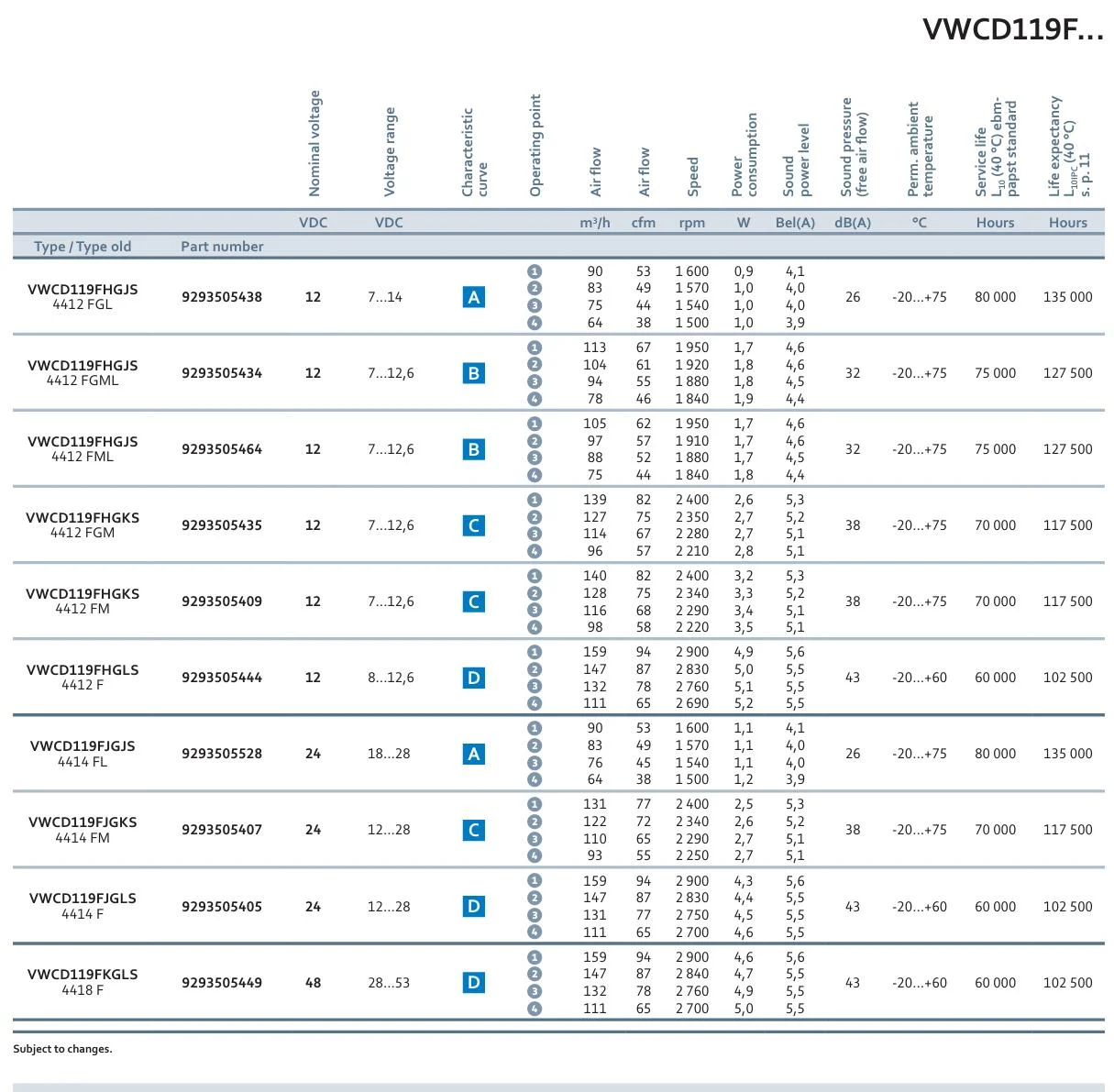
If you review an official ebmpapst datasheet today, you will frequently notice not one, but three distinct identification strings assigned to a single product. This triad—Part number, Type, and Type old—often confuses hardware designers, but it represents the historical evolution of ebmpapst’s global supply chain integration.
The Evolution of the Three Identifiers
- Type old: This is the legacy descriptive language. Historically, the separate entities that formed ebmpapst (ebm, PAPST, and mvl) had their own highly intuitive engineering languages. The “Type old” allows veteran engineers to read the string and instantly visualize the fan’s frame size, voltage, and aerodynamic profile. However, it lacks the strict structural uniformity needed for modern automated logistics.
- Type: The unified, modernized alphanumeric smart code (usually 12 characters). It bridges the gap by standardizing the nomenclature across all global facilities. It classifies products logically by basic function, exact millimeter dimensions, voltage class, and intelligent control features, ensuring industrial blowers and compact fans follow the exact same root logic.
- Part number: The 10-digit numerical code (e.g., starting with 9). This is the absolute source of truth in SAP/ERP systems. Two fans might share the same “Type old” aerodynamic performance, but if one features a 300 mm cable and the other a 500 mm cable with a specialized Molex connector, they will have entirely different Part numbers. For procurement and exact BOM replication, the Part number must be used.
Deep Dive Analysis: Decrypting the Triad with Real-World Examples
Case Study A: The High-Speed Centrifugal Blower
Part number: 9594314500
Type: VBS0140XUJCS
Type old: RER 140-22/14 N/2 TDP
The Breakdown:
- Type old (RER 140-22/14 N/2 TDP):
RER indicates a motorized centrifugal impeller, backward-curved, single inlet with no scroll.
140 is the diameter in mm.
-22 is the mechanical stator width.
/14 denotes 24 VDC.
N means standard/high speed.
/2 means it has a tacho output.
TDP highlights the PWM control input and advanced thermal monitoring.
- Type (VBS0140XUJCS):
VBS standardizes to Ventilator, Backward-curved, Single inlet.
0140 firmly states the 140 mm physical diameter.
X refers to the motor platform.
U is the modernized voltage class indicator for 24 VDC.
JCS is the feature block capturing the PWM interface and bearing type.
- Part number (9594314500): Secures the exact cable length, labeling, and packaging for this specific OEM iteration.
Case Study B: The Extreme Telecom Cooling Fan
Part number: 9295420302
Type: VWS0148PULDS
Type old: 6318 N/2TDH3P
The Breakdown:
- Type old (6318 N/2TDH3P):
6 represents the 172 mm (or 150 mm) round frame class.
3 is the heavy-duty 51 mm depth.
18 specifies 48 VDC nominal voltage.
N is the base series.
/2 indicates tacho feedback.
TD means PWM control.
H3 designates the S-Force extreme performance level.
P means a dedicated PWM interface.
- Type (VWS0148PULDS):
VWS stands for Ventilator, Wall-ring/tubeaxial shape.
0148 gives the exact internal impeller/aperture specification (148 mm).
P denotes the motor electronic generation.
U signifies the specific voltage class (operating range aligned with the 48 VDC requirement for this specific motor generation).
LDS captures the H3 extreme speed tuning and advanced sensor interfaces.
Case Study C: The Square Equipment Cooling Solution
Part number: 9294310605
Type: VWC0127YUJBS
Type old: 5214 NM
The Breakdown:
- Type old (5214 NM):
5 denotes the 127 x 127 mm square frame.
2 is the series depth of approximately 38 mm.
14 specifies 24 VDC.
N is the standard performance base.
M is the Medium speed variant, optimizing the balance between airflow and acoustics.
- Type (VWC0127YUJBS):
VWC categorizes it as a Ventilator, square Wall/Compact frame.
0127 explicitly lists the dimension as 127 mm.
Y is the motor platform.
U confirms the voltage class for 24 VDC (Typical range: 16.0 – 30.0 VDC).
JBS defines the medium-speed acoustic profile and standard electronic interfaces.
Streamlining Your Specification Process
By applying these comprehensive rules, engineers can accurately interpret ebmpapst part numbers to determine physical dimensions, input voltages (e.g., 14.0 – 27.6 VDC), and aerodynamic capabilities without immediate reliance on external documentation. When navigating the modern triad, use the “Type old” or “Type” to quickly understand the fan’s form factor and performance grade, but rely exclusively on the 10-digit Part number for final procurement.
While this naming logic provides robust initial guidance for component replacement and system design, we strongly recommend consulting the precise technical datasheets available on FansCo to verify exact Max. Air Flow (in m³/h) and Weight parameters prior to final system integration.